This guide describes how the accounting data must be exported from DATEV as a trial balance (“SuSa”) so that they can be imported into Finokapi as a basis for your financial planning & analysis.
Please note that a SuSa file always relates to an entire fiscal year. We recommend that you take into account at least 2 previous years when exporting for the first time and create a new export every month for the current fiscal year.
Step 1: Open ASCII-Export in DATEV
Please complete the following steps to create the SuSa files in the appropriate format for Finokapi:
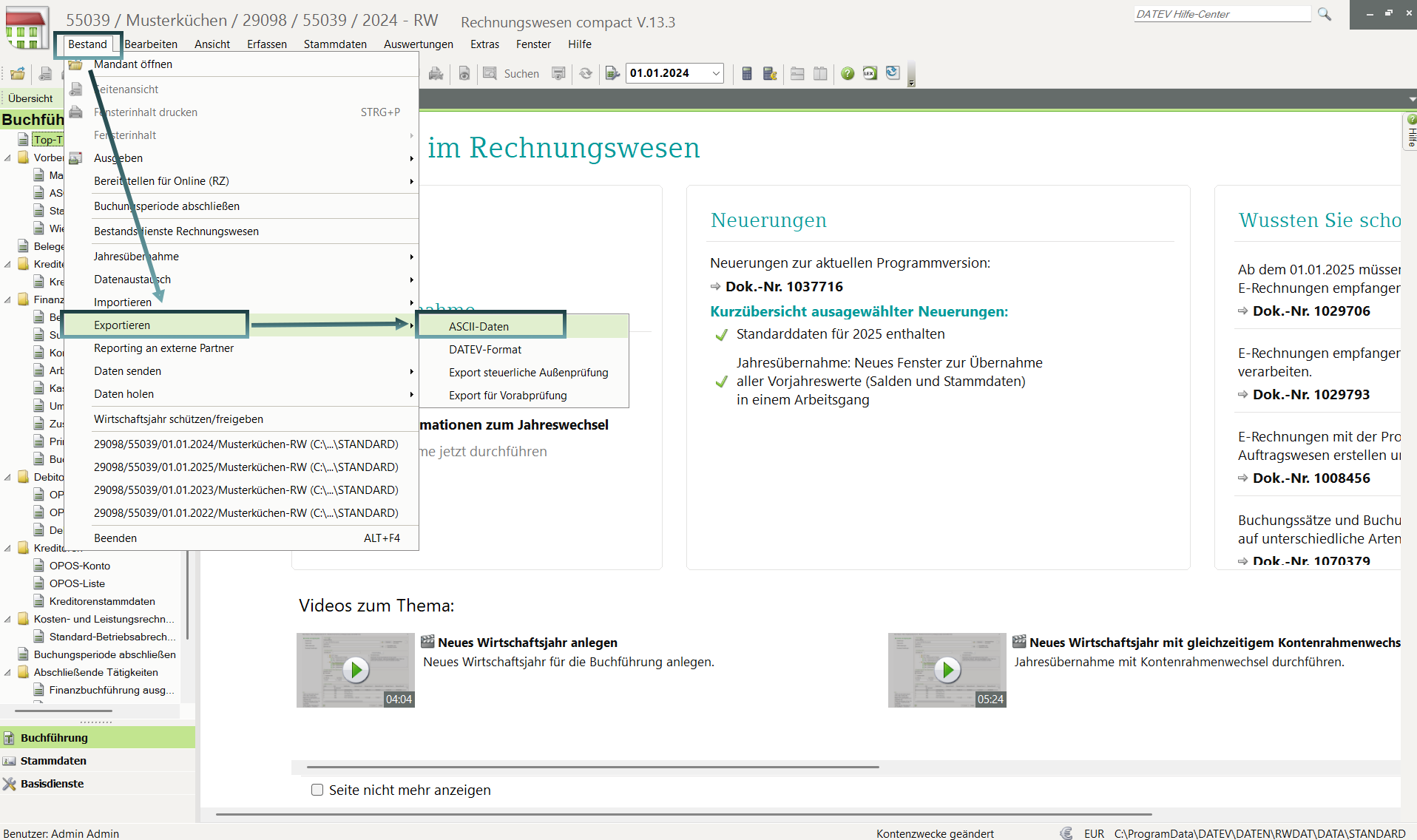
In DATEV Arbeitsplatz, open a fiscal year of the desired accounting client.
Now, in the menu on the upper left, click "Bestand" -> "Exportieren" -> "ASCII-Daten".
Step 2: Configure Finokapi format
Please click on the following button to download the Finokapi stylesheet first.
In the new window, click on “Format Management” -> “Import Format” and select the Finokapi-SUSA stylesheet. (This step only needs to be carried out once before the first export.)
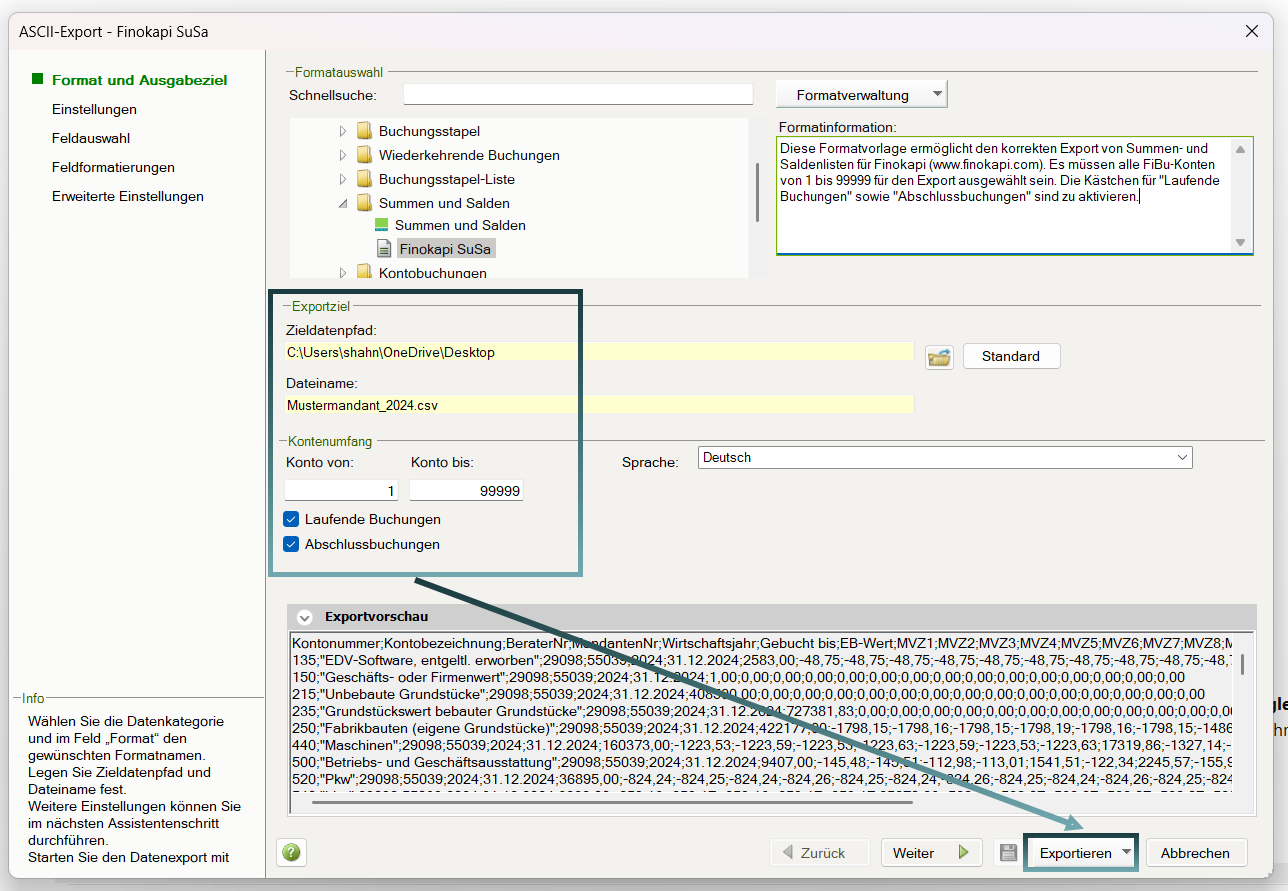
Now select the new format “Finokapi SuSa” in the “Format Selection” under “Totals and Balances”.
Good to know: The stylesheet was created directly in DATEV and is basically just a text file that contains instructions on how DATEV should format the export. You can view the contents of the file at any time by opening it with a text editor.
Please specify the storage location and a file name with the extension “.csv” and make sure that the account size is 1 to 99999 and that the two checkmarks are checked.
At the bottom right, click Export -> Export and Close. The SUSA file can now be found in the previously selected storage location.
Step 4: Upload SUSA file to Finokapi
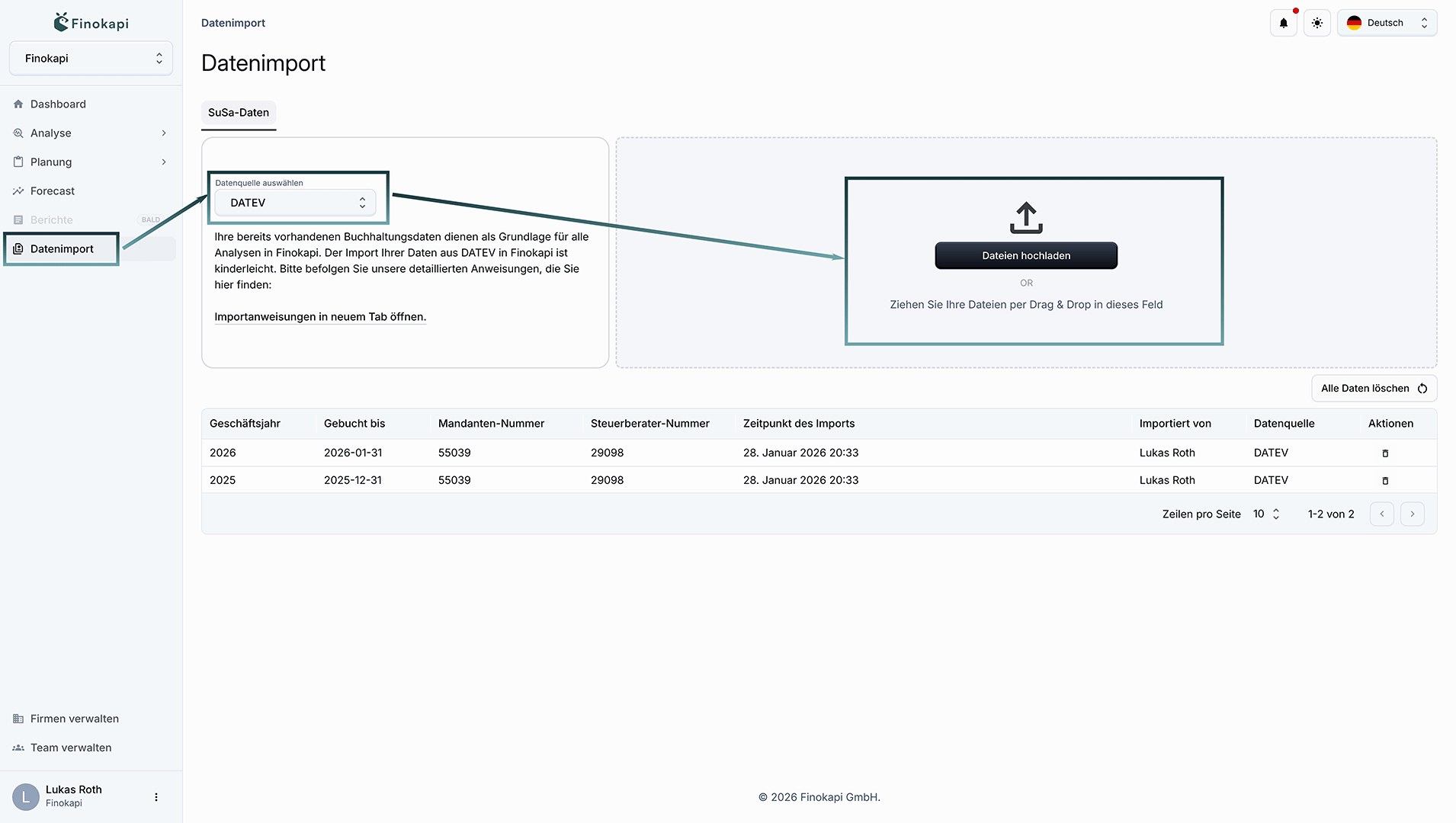
Geben Sie die Datei an die anfordernde Person weiter bzw. laden Sie sie selbst im Datenimport-Modul in Finokapi hoch.
Anleitung:
In Finokapi links auf Datenimport klicken.
Unter SuSa-Daten Ihre Datenquelle auswählen (z. B. DATEV, Agenda, Addison).
Datei per Drag & Drop hochladen oder Dateien hochladen klicken.


.png)